Crossing a system
Ships burn the whole way. Point at where you're going, thrust to the midpoint, flip over, and spend the rest of the trip slowing down.
A ship's fusion torch runs continuously from departure to arrival. You leave when you're ready, you burn the whole way, and you arrive a few days later.
Which means thrust is gravity. A ship burning at one gee has one gee of down, and down is toward the engines. Decks stack along the axis of thrust like floors in a building. A dropped cup falls. Coffee stays in the cup.
One gee is the standard cruise: comfortable for anyone, whatever they were born under, and it puts every port in the Fray within a week.
At the midpoint the drive cuts and the ship rotates end-for-end. For a few minutes there is no down at all, and everything not tied down goes drifting.
It's on the board, so everyone aboard knows exactly when it's coming. A crew that has drilled for turnover has half-drilled for the day the drive fails without asking.
Distances are one-way and star-relative. The trip assumes the ship burns the whole way.
| Distance | at 0.3 g | at 1 g | at 2 g | Speed at turnover | Radio round trip |
|---|---|---|---|---|---|
| 0.1 AU | 1.7 days | 22 hr | 15 hr | 383 km/s | 2 min |
| 0.5 AU | 3.7 days | 2.0 days | 1.4 days | 856 km/s | 8 min |
| 1 AU | 5.2 days | 2.9 days | 2.0 days | 1,211 km/s | 17 min |
| 2 AU | 7.4 days | 4.0 days | 2.9 days | 1,713 km/s | 33 min |
| 3 AU | 9.0 days | 5.0 days | 3.5 days | 2,098 km/s | 50 min |
| 5 AU | 11.7 days | 6.4 days | 4.5 days | 2,708 km/s | 83 min |
| 7 AU | 13.8 days | 7.6 days | 5.3 days | 3,205 km/s | 116 min |
| 10 AU | 16.5 days | 9.0 days | 6.4 days | 3,830 km/s | 166 min |
| 20 AU | 23.3 days | 12.8 days | 9.0 days | 5,417 km/s | 333 min |
| 30 AU | 28.6 days | 15.7 days | 11.1 days | 6,634 km/s | 499 min |
days ≈ 2.9 × √AU
At one gee, and accurate to two decimal places across the whole table.
Trip time goes as the square root of distance, so ten times as far costs only 3.2 times as long — most of a long burn is spent going preposterously fast. One AU is three days; ten AU is nine.
It also means shaving distance barely helps. Halving a run saves 30%. If a trip is running long, the answer is the throttle.
Every system's busiest port, and how long it takes to reach that system's crossings — its gates, or the point where a Leviathan's wake passes through. Typical geometry, at one gee.
| System | Main port | Crossings | Run to a crossing |
|---|---|---|---|
| Halcyon | Halcyon's Landing | 1 | 2.9 days |
| Meridian's Drift | Driftworks | 2 | 3.1–5.3 days |
| Thessaly Deep | Thessaly Station | 1 | 3.2 days |
| Tanager | Amaranth | 2 | 3.4–4.3 days |
| Kestrel Junction | The Exchange | 4 | 3.5–6.9 days |
| Vosk | Ironflats Station | 3 | 3.9–5.4 days |
| Widowreach | Reach-b | 1 | 3.9 days |
| Farrowhaven | Farrow's Anchorage | 1 | 5.0 days |
| Ophira | Ophira Prime | 2 | 6.5–7.8 days |
| Cindergate | Cinderhold | 3 | 6.7–7.6 days |
The Exchange, Cinderhold and Driftworks are docked at a crossing, so their run is nothing at all. That's economics: a gate is a fixed point every ship entering or leaving has to touch, which makes the space around it the most valuable real estate in the system. The Long Market is where it is because a market at a chokepoint sells to everyone.
The long hauls are to the places that aren't on a gate — the farms, the mines, and the people who would rather not be watched.
Ophira and Cindergate both orbit brilliant, hot stars, so their habitable zones sit three to five AU out and everything else is pushed out with them. Working the Cinder costs an extra three days each way, and its freight rates say so.
The outer outposts — the Tanager Shoals, Sable Deep, Sounding Post — are ten days and more from anywhere. That's the point of them.
Where you're from, at the throttle
One gee is cruise. A torch will do a great deal more than that, and crews push it when something is chasing them — but a hard burn is survived by the body, and the body was built somewhere.
Everyone can carry about a gee and a half more than they grew up under. That's your burn tolerance: the sustained acceleration at which you still work normally. Above it you're fighting your own weight.
The same number covers standing on a heavy world, because it's the same problem. Which means burn tolerance quietly decides where in the Fray you can go.
| Raised on | System | Native gravity | Burn tolerance |
|---|---|---|---|
| Ashvane | Cindergate | 0.25 g | 1.75 g |
| The Hollow Camp | Hollowmere | 0.25 g | 1.75 g |
| Millhaven | Tanager | 0.26 g | 1.75 g |
| Ceres Hollow | Ophira | 0.27 g | 1.75 g |
| Salvage Downs | Meridian's Drift | 0.30 g | 1.75 g |
| Thessaly Station | Thessaly Deep | 0.70 g spun | 2.25 g |
| Farrow's Anchorage | Farrowhaven | 0.70 g | 2.25 g |
| Driftworks | Meridian's Drift | 0.75 g spun | 2.25 g |
| Vosk's Hollow | Vosk | 0.78 g | 2.25 g |
| Aldergate | Kestrel Junction | 0.80 g | 2.25 g |
| Cinderhold | Cindergate | 0.85 g spun | 2.25 g |
| The Exchange | Kestrel Junction | 0.90 g spun | 2.50 g |
| Ophira Prime | Ophira | 1.00 g | 2.50 g |
| Amaranth | Tanager | 1.20 g | 2.75 g |
| Halcyon's Landing | Halcyon | 1.60 g | 3.00 g |
| Reach-b | Widowreach | 1.85 g | 3.25 g |
A consequence worth planning around
Take the ship to two and a half gees to shake a patrol cutter. Everyone raised on a station or a comfortable world is in a couch by then, vision narrowing, arms too heavy to lift off the armrest.
The stocky woman from Reach-b is sitting up and flying. Two and a half gees is most of a gee inside what she grew up carrying — it's a bad afternoon, not an emergency. She's not at the controls because she's the designated pilot. She's at the controls because she's the only one still able to reach them.
It runs the other way too. Someone born on Millhaven at a quarter gee tops out below two, and there are worlds in the Fray — Halcyon's Landing, Reach-b — where they simply cannot stand up unaided. A low-g spacer travels the sector freely and steps onto very little of it.
A ship under thrust is the brightest thing for an enormous distance in every direction, and there's no muffling it. Anyone with a telescope knows where you are, what you're pulling, and roughly what class of drive you're running.
Shut the torch down and coast ballistic on the velocity you already had. A four-day run becomes months. Smuggling in the Fray is patience, forged codes and a bought Gatewatch officer — not stealth hulls.
Shedding a torch's waste heat takes hundreds of metres of thin glowing fin. They can't be armoured, they can't be hidden, and they're the first thing a gunner aims at. Lose them and you throttle down to a crawl or you cook.
The door at the end of the run
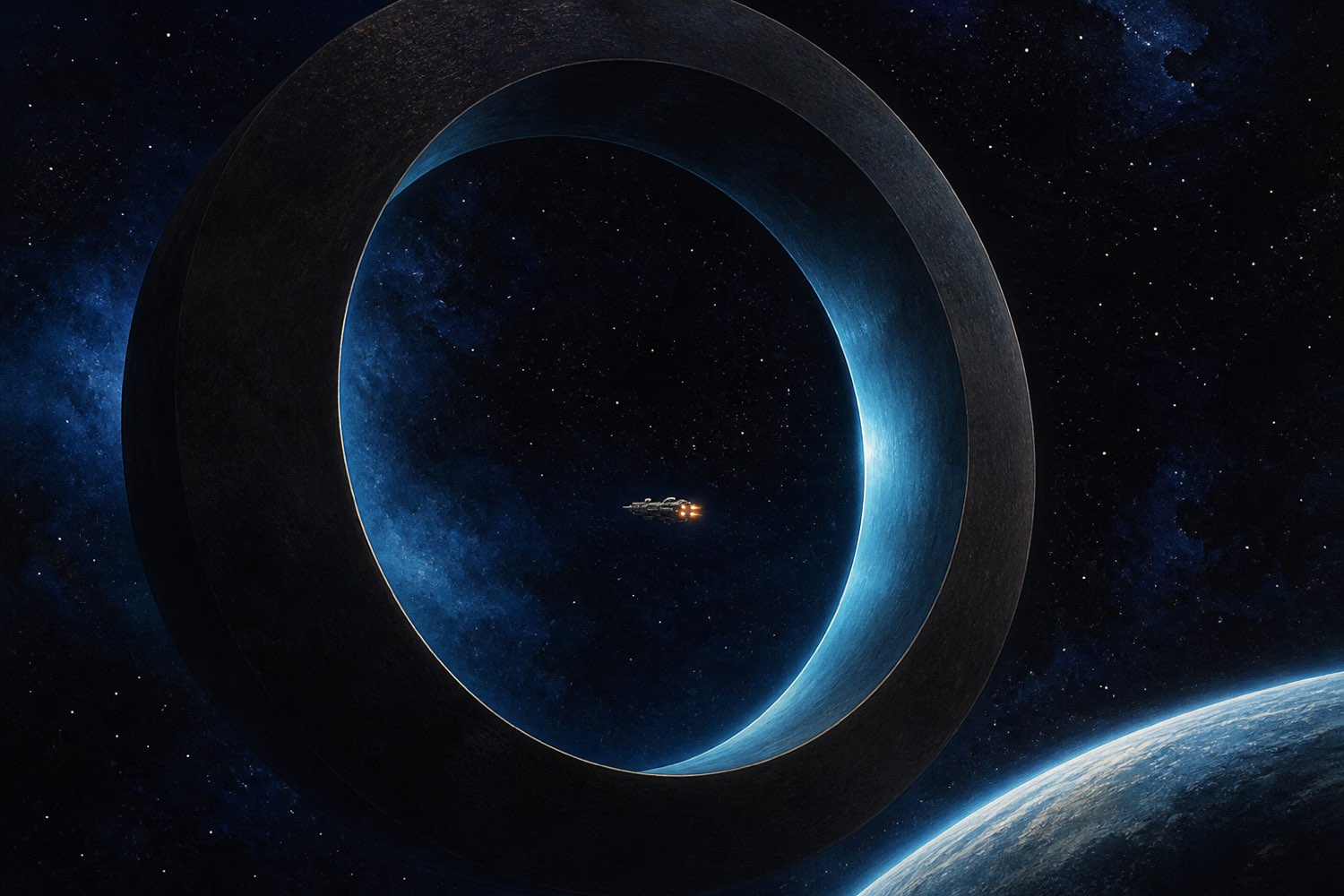
Every crossing in the Fray ends at a ring kilometres across that nobody built, nobody can move, and nobody can open. The largest freighter in the sector goes through the middle of one looking like a moth in a barn door.
A gate does not orbit. It holds a fixed distance and bearing from its star and simply stays there, while the whole system sweeps past it. It has done that for every year anyone has kept records, and no explanation has ever survived contact with the Ophira Athenaeum.
It isn't too light to care, either. A gate has the mass of a small moon — and a small moon at that distance falls into its star like anything else. This one doesn't.
Which is how ports work. Nothing is attached to a gate; nothing could be. The ring is heavy enough that a station simply orbits it, the way a moon orbits a world. Driftworks circles the Tanager gate at Meridian's Drift, 42 km out, once every 63 minutes.
A port orbits one ring, not the system. Meridian's Drift has two of them and only one gate port, which is a large part of why that particular crossing, and not the other three, is the one that sets prices in the Fray.
Which sounds frantic, and isn't — it's a very small circle. The station is doing about 70 metres a second, slower than a groundcar on an open road. Crossing from the ring to the docks is a short, gentle burn.
The crossing itself takes no time at all. You go through and you're on the other side; clocks agree at both ends, and crews describe it the same way every time — the stars change, and that's all that happens.
So a gate is a door, not a road. Nothing is ever in one: no middle to hide in, nothing to intercept between systems, no ship overdue in the passage. Every hour of a run is spent on one side or the other, in normal space, under a torch, where somebody can find you — which means the dangerous part of the journey is all of it except the door.
A gate is shut most of the time. It opens for a few hours, on its own schedule, and then it closes. Two centuries of trying have not moved that schedule by a second.
What the Fray has instead is tables. The intervals aren't even — a gate averaging 44 hours gives you 41, then 48, then 43 — but the sequence repeats reliably enough to print a year out and be right to the minute. Humanity predicts the gates the way it predicted tides for centuries before it understood them.
| Pair | Opens every | Aperture | Typical wait | Open per week |
|---|---|---|---|---|
| Kestrel Junction ↔ Tanager | 31 h ±4 | 5.2 h | 12.9 h | 28.2 h |
| Kestrel Junction ↔ Vosk | 44 h ±5 | 4.0 h | 20.0 h | 15.3 h |
| Kestrel Junction ↔ Ophira | 63 h ±9 | 3.1 h | 1.2 days | 8.3 h |
| Meridian's Drift ↔ Tanager | 71 h ±8 | 3.4 h | 1.4 days | 8.0 h |
| Cindergate ↔ Kestrel Junction | 58 h ±7 | 2.6 h | 1.2 days | 7.5 h |
| Cindergate ↔ Ophira | 88 h ±10 | 2.8 h | 1.8 days | 5.3 h |
| Cindergate ↔ Meridian's Drift | 79 h ±12 | 2.3 h | 1.6 days | 4.9 h |
| Halcyon ↔ Vosk | 96 h ±14 | 1.9 h | 2.0 days | 3.3 h |
| Thessaly Deep ↔ Vosk | 112 h ±11 | 2.2 h | 2.3 days | 3.3 h |
A flat band, square-edged, the same depth front to back as it is wide. No seams, no plating, no ports, no lights, no moving parts — nothing anywhere on a gate that looks like a mechanism, or like it was assembled. It looks the way a river stone looks: one piece of something, shaped, with no account of the shaping.
Its opening is 6.0 km across, 9.6 km on the outside, and it masses 3.1 × 10¹⁸ kg, which puts the material at about 39 kg per cubic centimetre. A sugar cube of it weighs as much as a full drum of water. Nothing outside the corpse of a star is that dense.
Nothing humanity owns marks a gate, and there is nothing to anchor to. Close in it pulls like a very heavy wire instead of a planet — 1.9 g at the face, still 0.44 g three kilometres off it — and it keeps its grip a long way out. The weight is workable. The reach is what catches people.
In the plane of the ring that pull is toward the ring, and worse the closer you drift. At the dead centre of the opening it cancels to nothing. That's why transits run down the axis: the safe corridor is a real, narrow, physical thing.
A moon falls around the star along with its planet, so the star's pull all but cancels out. A gate doesn't fall — so a station orbiting one carries the star's full weight as a steady sideways drag, and past a certain radius that drag wins and the orbit comes apart.
At Meridian's Drift the ceiling is 215 km. Out at Cindergate, further from a cooler star, it's 614 km. Berths sit well inside it, and there is only so much of that sky to go round.
Kestrel Junction is the hub because its doors open more than anyone else's — twenty-eight hours a week to Tanager alone, which is why grain moves in bulk and why the Exchange sets prices. Halcyon is a backwater because four days of waiting buys it under two hours of open gate.
A gate window is a ferry: you make it or you wait days. Finding out a gate opens in forty hours when you're sixty out at cruise costs reaction mass, or crew who can't take the burn, or the window. Every option is expensive, which is what makes it a decision.
A window is the one time the whole system's traffic converges on one point: the ship you're avoiding, the inspector you paid, the courier carrying the warrant. Make it and you're gone for days. Miss it by twenty minutes and so has your pursuer.
One ring that does not cross cleanly
Every gate in the Fray puts a ship through instantly. One doesn't. The Tanager gate at Meridian's Drift opens exactly on schedule, to the same second as its far end, like any other pair — and then fumbles the crossing.
Usually a ship comes out an hour or two late, which at the Drift is routine enough that traffic control just holds the slot. Sometimes it comes out an hour before it went in, on a clock everyone agrees on. And a few dozen times in two centuries, a ship has come out of a gate that isn't Tanager's at all, somewhere it had no business reaching. Not all of those ships arrived intact; Salvage Downs has made a living off the ones that didn't.
The slip has never once been wider than the window, so nobody has yet been put through into a shut gate. Nobody knows if that's a mercy, a clue, or an accident still pending. Causality, meanwhile, is a problem the Fray has declined to have: the interval is small, the next opening back is days away, and in two hundred years nobody has managed a paradox. Gatewatch files an arrival stamped before its own departure as a negative interval and forgets about it.
All of which makes the Drift the one place in the Fray where a ship can turn up where it shouldn't be, with a record that doesn't add up, and have the official, boring explanation be the Drift did it again. Every Gatewatch office knows this is abused. None can prove which arrivals are real. Crews call a laundered arrival a drift, and Driftworks charges accordingly.
One ring that has never opened
At 1.7 AU from Rasmene, holding station at exactly the distance the Thessaly ruin field orbits, there is a tenth ring. It is the same size as a working gate, made of the same material, scoured on the inside the same way — which means it worked once, for something, for a long time.
It has never opened. Two hundred and fourteen years of continuous watch, and the aperture has stayed dark for every hour of it.
It is also not inert. Instruments pressed to the ring pick up the slow counting rhythm every working gate keeps between openings — roughly every 137 hours, wandering the way they all wander. The Sill reaches the end of its count, and nothing happens, and it starts again. It has done that half a million times while people watched.
Nobody knows where its pair is, and there is no way to ask. If it opened it would attach a star system nobody has seen to the Fray in a single instant — and if that system has gates of its own, everything those reach as well. Which is the actual reason two wealthy systems quietly bankroll a poor research station on the far edge of human space. The ruin field is the version that fits in a grant application.